
Process plant engineering
Plant problems first.
AI when it fits.
We work with process plants to identify operational, reliability and performance problems, connect the required plant information, and determine the most practical response — from work-process and control improvements to analytics, software or AI.

Working flow
- Problem What plant problem are we trying to solve?
- Evidence What data, documents, observations and engineering knowledge are available?
- Options What is the simplest practical response? Process change, instrumentation, control, analytics, software or AI.
- Decision Plant staff decide what should proceed.
- Pilot Test at manageable scale.
- Measure Did it actually improve the problem?
Context
Practical plant work, not technology for its own sake
Plants have to keep running. People rarely have spare time for long training and double work. The useful starting point is the plant problem and the evidence around it — not a new tool layered on disconnected data and unclear ownership.
The answer may be a work-process change, better instrumentation, reliability work, conventional analytics, first-principles engineering, commercial software, purpose-built software, or AI — depending on the problem.
Working methodology
A simple decision loop
Collect → Connect → Contextualize → Communicate → Confirm. Your staff still own the safe, approved action at each step.

Matching the response
Different problems need different responses
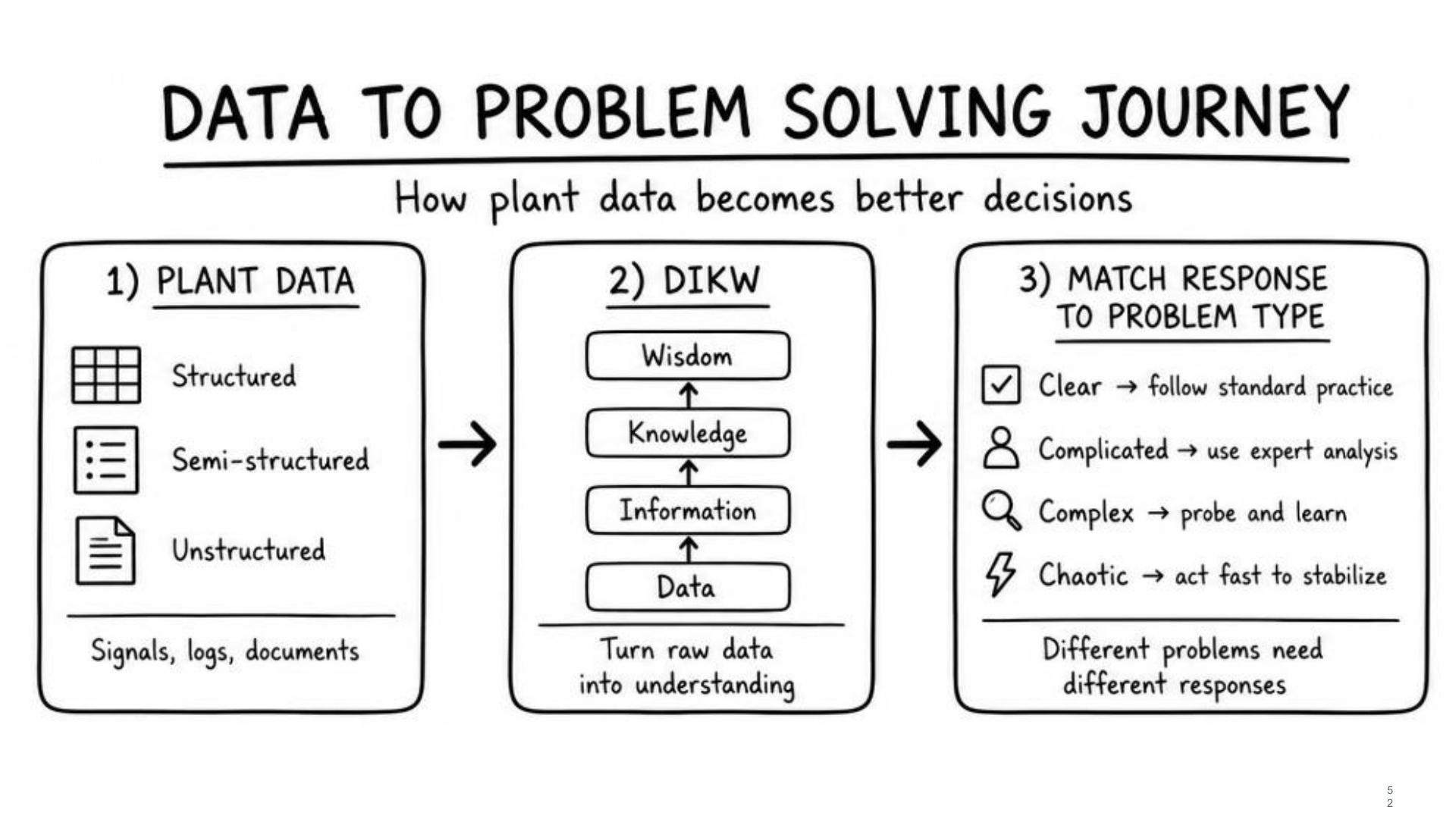
Not every issue needs advanced analytics or AI. Some need better data, clearer procedures, or a control improvement. The sketch below shows how plant information can move toward understanding — and how the response should match the type of problem.
Keep people in charge
AI suggests. Your staff decide.
AI may organize information, find patterns, retrieve relevant knowledge, summarize evidence, or suggest possible actions. Your people check plant reality and risk, then approve the action according to existing engineering, operational, safety and management processes.
